
Play TV Canada Pwned: Going Off the Air March 26th

Previously on MikeBattista.com: I complained about a televised scam called Play TV Canada, then examined the nature of the fraud in more detail, and got a response from Global Television.

Global never responded to a follow-up letter highlighting the inadequacy of their justifications. However, every weekend, thousands of people have Googled their way to this blog, and hundreds have commented (especially here), collaborating to find a way to stop these unscrupulous people.

Well, good news! A commenter named Jeremy received the following letter:

“We are in receipt of your letter via the CBSC regarding Global Television’s broadcast of Play-TV Canada, February 20th 2010, on Global Toronto (CIII). In your letter, you have expressed concerns regarding this show suggesting it may be a scamming game show, with no logical answers to impossible questions.

Let me begin by saying that as responsible broadcasters, we are sensitive to the members of our viewing audience and we apologize if this program has offended you. I assure you that it is neither Global’s nor the producer’s intention to do so. As of March 2010, our contract with Play TV will end and the show will no longer air on Global Television.”

He added:

LOL PWN I GOT THEM TO REMOVE THE MOTHER F*****KING SHOW YAYYYYYYYYYYYYYYYYYYYYYYYY

March 26th they’re done.

I made them cancel their contract with them..
I’m a god!!!!!!!!!!!!

As of March 26th, Play TV Canada will no longer be airing. I’m sure this will be justified by falling ratings or other financial reasons. However, while I wouldn’t give this blog, or Jeremy, sole credit for Play TV’s downfall, I have no doubt that our collective complaining and bad publicity had an impact on the decision to end this contract.

A few people are worth singling out in this effort.

  • Jeremy, obviously, who complained and was kind enough to report back here.
  • Dave from CrimeBustersNow, who passion for exposing and taking down scams like this is personal and intense. We need more people like him around. See CBNow’s Post about Global and Play TV.
  • Lisa from Dublin, who brought information from the other, older front in this battle, Ireland. Over there, similar circumstances lead to Play TV’s downfall.

It looks like the next battle site is South Africa. There is a discussion forum for it here, and obviously people are welcome to continue using the comments here as a venue for discussion. Dave suggests further action here in Canada as well, such as trying to push for criminal charges. While I’m not sure about going that far, it is worth considering if you have the time and motivation.

Thanks to everyone who has followed and participated in this international effort. Score one for the good guys.

Book Review: Marvellous Hairy, by Mark A. Rayner

The copy on the back of Marvellous Hairy bills it as a novel about a man who is turning into a monkey. However, it goes far beyond that. The story revolves around a giant, evil corporation nicknamed Gargantuan Enterprises and the people who want to bring it down, then before you know it, there are ghosts, kidnapping, lizards, sex, and drugs thrown in for good measure.
Let me make a confession: I don’t find monkeys inherently funny. Their similarity to humans is amusing, sure, but it’s been overdone. Given the premise of Marvellous Hairy, I was a bit worried that its humour would rely on “anything is funny if you mention the word monkey alongside it” school of thought. Luckily, its absurdity is only partially monkey-based, and it delivers some genuine funny. Many scenes had me smirking as hard as I have at any Douglas Adams novel (yeah, just smirking; it takes a lot for me to physically LOL at text).

A lot of the books I’ve reviewed recently, they’ve been trashily entertaining (see: Charlaine Harris), or had great ideas despite mediocre writing (see: Cory Doctorow). But Rayner is actually a damn good writer. Every paragraph is packed with clever wordplay and subtle allusions. E.g., “He had long greasy black hair that clung to his head like an octopus humping his skull” (ok ok, maybe not always subtle).

Not all is warm and fuzzy. The novel could have used some edits; the language can be wordy, the plot takes a while to get going, and a certain subplot doesn’t feel like it fully connects with the rest of the story. Also, the quasi-omnipotent first-person narrative is jarring, especially when it needs to be explained, though it does add to the surreal bizarreness of the whole thing.

That is where Marvellous Hairy shines: it is such a bizarre barrel of words that you can’t help but have fun reading it. Mark (full disclosure: I can go all first-name-basis because we’ve met IRL) recently tweeted that his next novel may be even sillier, and if that’s the case, I can’t wait to get my paws on whatever he comes up with.

Book Review: Freakonomics, by Steven D. Levitt and Stephen J. Dubner

I’ll keep this short, because Freakonomics is a pretty simple book. It takes a look at various topics—the effect of names on success, drug dealer salaries, cheating in sumo wrestling, etc.—through the eyes of an economist.

This book is a few years old (and has a sequel out now), and it took me a while to get through it, mostly because it’s been my “sit on the bedstand and read for a few minutes before bed” book for a long time. And that’s the ideal context for it. Read a few interesting facts, go “huh, that was interesting,” then put it aside and go to sleep.

There’s some weird deifying of Levitt that just feels out of place, but aside from that, the authors do a good job of merging interesting anecdotes with potentially dry number crunching. The accuracy of the conclusions is sometimes questionable, though. While there is a section about the difference between correlation and causation, causal claims based on correlational data are still presented with more certainty than is warranted.

Much has been made about some of the more controversial topics in here, such as racism, and abortion. For example, they claim that legalizing abortion can lead to a drop in crime rates years afterwards. This may be true (or may not)—and certainly this fact should inform moral judgments about abortion—but the fact itself has no morality attached to it. Presenting such a fact is not a moral stance. Information itself is neutral; it’s what we do with it that determines morality.

Anyway, I’d recommend Freakonomics as a nice little entertaining read for anyone interested in some offbeat conclusions that have been drawn from studying economics. I wouldn’t take it any further than that.

Play TV Canada Complaint: Global’s Response

If you’ve been following this blog, you know that I have, for some reason, been battling against crappy television.

I sent the following to the Canadian Broadcast Standards Council a few weeks ago:

Hello. I have sent this concern to Global Television directly, but heard no response.

This “show” is a blatant scam, for several reasons. In sum, they make implicit promises (e.g., that it is possible to get through, or that the puzzles they present are solvable) that are not kept, which defrauds people of money. I do not believe that such an unethical practice should be encouraged by allowing it air time.

I have laid out many of the details of my concern in these blog posts:

Play TV Canada is a Scam
Play TV Canada Has No Legs

And I see that a CBSC decision has already been made about an identical scam: here (also here). But it it still on the air, so I’d like to lodge yet another complaint.

I hope there is something you can do about this. Thank you very much for your time.

My letter was forwarded to Canwest/Global (the company that airs, but does not produce, the program). I recently got a response. The letter can be viewed here.

I will compose a formal response soon. But a few things worth noting right away:
1) Staring at an unsolvable puzzle for 2 hours is not entertaining nor informative for any age, interest, or taste.
2) Having it be for ages 18+ is no excuse. It’s like, “but officer, the person I pickpocketed was 18! Should’ve known to be on the lookout for criminals.”
3) They did not address the implicit promises that are broken (e.g., the fake timer, the non-ringing phone, the random timing of getting on the air). Tiny text at the bottom does not excuse the lying host blabbering up top.
4) There is clearly not one and only one answer to each puzzle.

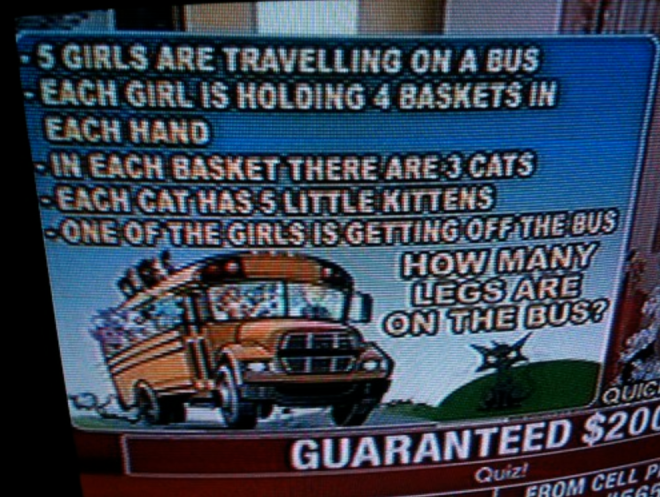
This last point is exemplified by last night’s “episode”:

The “correct” answer was 449.

Plugging in the same assumptions as the last bus/cat/leg puzzle does not get to the “correct” answer (even after accounting for, say, one girl having a leg off the bus, or one basket off the bus, etc.) The scam is in including assumptions that cannot possibly be uniquely derived from the question. Can anyone use their psychic powers to divine what arbitrary assumptions could lead to 449?

P.S. I found it rather funny when the host slipped up last night and said “euros” instead of dollars. It highlights that this cheaply produced crap is pumped in from halfway across the world just so Global can make a few bucks.

P.P.S. Here are some videos you might enjoy. 🙂

Play TV Canada Has No Legs

As a follow-up to my post Play TV Canada is a Scam, I watched it again last night. Once again, I couldn’t turn away; it’s like a train wreck. A train wreck with the conductor begging you for money while he wades through the victims.

One such victim was brave enough to speak up last night. What sounded like an older gentlemen said, through beeped out swearing, something like “you people sure are takin’ advantage of a lot of people, and I oughta-” before he got cut off. Good for you, angry old man. You’re fighting the good fight.

Here is one of last night’s “puzzles”:

I’ll write it out:

  • 4 girls are travelling on a bus
  • each of them have 3 baskets
  • in each basket there are 4 cats
  • each cat has 3 little kittens

HOW MANY LEGS ARE IN THE BUS?

Plastered on the bumper of the picture of the bus, for some reason, it says “1 cat 4 feet.”

The host constantly emphasized that this is a simple logic puzzle. And indeed, it does seem to be a straightforward math problem. Hey, let’s figure it out!

All we need to do is figure out how many cats there are, and how many humans there are, then count their legs. Let’s do cats first. There are 4 girls, with 3 baskets each, so there are 4*3 = 12 baskets. In each basket there are 4 cats, and each of them has 3 kittens, so each basket has 4*3 = 12 cats. With 12 baskets and 12 cats in each one, there are 12*12 = 144 cats.
[Edit: whoops… Heather on Facebook pointed out that I forgot to count the 4 cats in each basket. It should be 16 cats/kittens per basket.]

How about humans? Well, the question only said there are 4 girls travelling on the bus, so 4.

Each cat has 4 legs. 144 cats times 4 legs = 576 cat legs.
Each person has 2 legs. 4 people times 2 legs = 8 human legs.

Which brings us to a grand total of 584.

Someone called in with this answer. “No, I’m sorry, that’s not it,” said the host.

What? Well, we must have missed something. Hmm, ok they’re going by bus, maybe it’s reasonable to assume that there is a driver, even though the question doesn’t say that. He or she has two more legs, so that brings the total to 586.

Someone called this in. “Nooo, sorry.”

Maybe they’re counting the “legs” of each seat, and we’re supposed to use our psychic powers to determine how many seats this fictional bus has, then get some answer larger than 586. In any case, I couldn’t stand that crap any longer, so I shut it off.

Then, in the comments to my last post about this, Kathy (who actually managed to win some money from these people, but still doesn’t recommend calling), managed to wait until the end: “Well, of course no-one got the ‘right’ answer of 222 legs.”

what? Even if you add other ridiculous assumptions, the answer can’t be less than 586.

They don’t reveal how the answer was arrived at, so there is no way of verifying their solution. Even if there was (e.g., “lol, we meant kitten fetuses without fully developed legs”), it’s not the straightforward solution that they explicitly claim it is. PlayTV is a despicable scam. It’s not impossible to win, but the conditions of winning that they describe are completely different than the actual conditions of winning.

If you want to get involved in shutting Play TV (a.k.a. CallTV) down:

P.S. Please, debate and dispute my math. I’d love to see how anyone can get 222 out of that.

UPDATE: Gavin on Facebook made the suggestion that maybe the kittens aren’t actually in the bus (i.e., the cats “have” kittens in the sense that a person can “have kids” even if they’re not present at the time).

So ignoring the kittens:

4*3*4 cats * 4 legs = 192 cat legs.
4 girls + 1 driver * 2 legs = 10 human legs.
5 seats to sit in * 4 legs = 20 chair legs.

= 222 legs.

Which is the “right” answer. I guess that almost makes sense, except none of the weird assumptions are actually in the question, and what kind of bus only has 5 seats?

That’s right, the short bus. Which is probably what whoever wrote this quiz was riding.

PlayTV Canada (aka The Quiz Hour aka Money Wave aka Game Time aka Call TV aka Nameless TLN / CHCH Call-in Game Show aka L’Instant Gagnant) is a Scam

I see this “show” on sometimes when I flip on the TV before bed, and I can’t turn away. It’s the most boring thing you could think of: this guy stands there, with some sort of “puzzle” on the screen, and he says that time is running out for someone to call in, give the solution to the puzzle, and win $500. That’s it. He stands there, babbling, waiting for the phone to ring.

The thing is, it’s a blatant scam. These people use subtle and not-so-subtle psychological tricks to persuade people to dial a number that costs $2.00 to call. For example, there is constant time pressure. The guy will put a countdown on the screen until the end of the contest. When it runs out he’ll pretend he’s fighting the producers to extend the deadline. The whole time, his phone sits there, not ringing. So you feel like, wow, this seems fishy, but I gotta decide right now, nobody else is calling, and the puzzle is easy (see above), so I’m guaranteed $500!

Another variation on the scam is putting up a “puzzle” with the terms of the solution so vague that it’s pretty much guessing at random answers. Then, even if you get through, you’ll get it wrong. Last night they showed a picture, and the puzzle was “how many hearts are in the picture?” But there were hearts within hearts, partial hearts, hearts that were covered but could be inferred, hearts too small to see, etc. Depending on which assumptions you include or exclude, there is a very large number of reasonable answers. So you hear people getting through occasionally, but they’re all wrong.

The underlying scam is in fine text at the bottom: “calling in enters you into a random draw to give a guess on the air.” So they arbitrarily decide when to air someone’s guess. They no doubt time it for the maximum illusion that not many people are calling, so if you call, you will surely win. Meanwhile, thousands of people are calling in at $2.00 a call. At the end of the show, they finally allow someone to get through on the easy puzzle, give them $500, then these assholes walk away with a profit of tens of thousands of dollars.

Yet, even knowing it’s a scam, I can’t turn away. Hearing the poor (probably literally poor) confused people get on the air, falling for the greedy tricks, it’s like witnessing a crime. So bottom line: screw you, PlayTV Canada. And a bonus screw you to Global Television for allowing this morally bankrupt crap to air.


Update March 28 2011: Apparently the show is back on the air under the name “Game Time” (presumably so people can’t Google up all the bad press under the original name). Hopefully writing Game Time here will alleviate that a bit. Game Time. 🙂

Also, if you’re new to this blog, there are some other posts on the topic:

And be sure to check out the comments below. There is some good info about what people have been doing about this show.


Update April 24 2012: The show is still airing on TLN, but apparently now they have resorted to not even mentioning the name of the show, for maximum non-Googleability. If you needed proof that they are sketchy, there’s even more.

Also, Telemedia, the people behind this crap, took down the video in this post due to a “copyright violation.” It was likely legal for me to use it under fair use (it was only a minute, and provided as context for the commentary), but I really don’t feel like fighting it. I doubt they would’ve taken down a video with me saying nice things about them though. If you needed even more proof that they are sketchy, well, case closed.

FOR NOW.

Normal Activity

It’s Halloween time, so as one would expect, many ghostly happenings have been … happening.

A few nights ago I had a lovely date night with myself. I got some snacks and some wine, turned off all the lights except for a single candle, and sat down to watch a scary movie. I’d never seen The Changeling before, but it had a few rare moments of freaking the hell out of me with its simple but effective scares. It’s all the ghost story clichés done right.

Then today, at the Central Library, I went to see a talk by ghost researcher Cameron Bagg, who presented these same ghost clichés as fact. It was an interesting presentation; he told the story of how he first encountered ghosts (mysterious sounds, feeling a presence, teleporting objects, etc.), the tools he uses to hunt ghosts, some spooky anecdotes, all that. He showed some pictures of ghosts and spirit orbs. Ambiguous shadows and spheres of light.

At strange gatherings like this, I find the audience makeup and reactions as fascinating as the talk itself. This was a diverse group of people – old, young, crazy, not-crazy. Good old Roy McDonald was in attendance (he seems to be everywhere at once … like a ghost). And their reactions; well, I think this was the defining moment:

Bagg took out a television remote control. A regular remote, with an infrared transmitter on the end. He pointed it at the audience, clicked a button a few times, and said “does everyone see the flashing light?”

Many in the audience nodded. Murmurs of “ah, yes!” and “I see it!”

But there was no flashing light. His point was that cameras can see frequencies of light that are invisible to the naked eye (e.g., infrared; indeed, a flashing light could be seen when he pointed it through a camera). But there is a deeper point that inadvertently came out: when people are presented with a suggestion, they are likely to see things as consistent with that suggestion. When shown a static bulb and told it was flashing, many people in the audience, they literally thought they saw it flashing.

Similarly, when someone believes she is about to see ghost photographs, then you show her a shapeless shadow, she will see a human figure in it. Suggest that a dead woman lived in a house, and a picture of an empty room contains her face in a blob of reflected light. The noises at night aren’t the people in the next apartment bumping around, but ghostly rapping. An object appearing where it shouldn’t isn’t a lapse in memory, but a mischievous poltergeist.

I’m not saying ghosts aren’t real. Ghosts are an intense phenomenon genuinely experienced by a significant proportion of the population. These experiences can’t be explained by the speculations of armchair debunkers, and even though I wish he was more objective about it, I am glad that people like Cameron Bagg are out there actually trying to figure it out. But aside from any paranormal explanations, there is a lot of equally fascinating normal human psychology going on in the minds of those looking for ghosts.

Book Review: Under the Banner of Heaven, by Jon Krakauer

Under the Banner of Heaven tells three interwoven true stories: the history of the Mormon faith, the current life of Mormon fundamentalists, and the 1984 murders of an innocent woman and her baby daughter at the hands of brothers Ron and Dan Lafferty, two such fundamentalists. The implication is that the Lafferty murders were not an isolated incident, and indeed, the history and current practice of Mormonism are littered with acts of brutal violence.

Krakauer writes as if he takes the insane things that the killers and other Mormons believe at face value. It’s sort of an inside perspective, describing not what is objectively true, but what the major players believe to be true. This can be humourous when writing about, say, Dan thinking that his bowel movements are a sign from God. Krakauer doesn’t need to inject his own opinion into the descriptions; the stories are ridiculous enough in a straight telling.

That same matter-of-fact style can also be heartbreaking. Like when describing the Mountain Meadows massacre, in which Mormon militia slaughtered an entire wagon train of innocent travelers. Or when the timeline of the Lafferty murders is described in great detail, partly through Dan Lafferty’s own unrepentant words (Krakauer interviewed him directly in prison, where as far as I can tell, he still lives to this day). It’s hard to understand how any sane person could murder a baby.

Yet Krakauer argues that the Lafferties are not insane. The take-it-at-face-value writing underscores that, given what the brothers believed and their rationalizations for any setbacks, they acted rationally. At worst, he identifies Ron as having symptoms of narcissistic personality disorder. The combination of the radical beliefs of Mormon fundamentalists, coupled with an extreme personality — the same sort of personality that has fueled the prophets behind all of Mormonism’s violent history — can be a dangerous mix.

This quote illustrates some of the workings of extreme religious minds:

“In one of Ron’s revelations, God had, in fact, instructed him to send his brother Mark to Nevada to wager on a horse to race to raise funds for the City of Refuge. With the Lord letting Mark know which mount to bet on, it seemed that they couldn’t lose. But they did. Afterward, Onias couldn’t resist telling the brothers ‘I told you so,’ causing relations between Ron and the prophet to deteriorate even further.”

With examples like these, on top of more serious ones, it’s difficult to imagine how anyone could believe in prophets. In the history of mankind, no prophecy capable of coming true has ever come true. Ever. The bickering and splintering of the church over whose “divine” revelation is better further emphasizes that they are pure fantasy. Yet people do believe. There are over 13 million Mormons worldwide, their faith based on a prophet who, less than 200 years ago, claimed to have “translated” a book of golden plates an angel showed him in the woods, by putting a magical rock in a hat then stuffing his face in the hat. And these are the less delusional, non-fundamentalist ones.

What may disturb readers is that their own beliefs — especially other religious ones, but this applies to some atheists too — could be just as unfounded and dangerous if left unchecked. Krakauer briefly makes an explicit link with Christianity, but I think the lessons of this book are even broader. All beliefs should be questioned, as should all sources of authority – be it the voice of God, a charismatic prophet, or Richard Dawkins.

If I had to complain about one aspect of the book, it would be its overemphasis on polygamy. The polygamist relationships of both modern and historical Mormons are whipped out as if the mere mention of multiple partners should send shivers up the reader’s spine. I may write a follow-up post to this, but my opinion, in short, is that it’s not polygamy itself that is troubling. Rather, it is the irrational beliefs that are the cause of polygamy in Mormons, and the monumental abuse of women and girls that polygamy often (but not always) leads to, that should be eradicated.

Sarah lent me this book, thinking it’d be up my alley, and she was so right. It’s hard to say I “liked” it, since much of my reaction to it is jaw-dropped horror, but especially in the early chapters when both the historical background and the murder story are fresh, it is an astounding, mind-blowing read. Anyone with any interest in religious belief, true crime, or both, should pick up Under the Banner of Heaven immediately.

Reaction to Accusations of Police Brutality at the University of Western Ontario

Yesterday, a crazy person rampaged through the Social Science Centre at the University of Western Ontario – the building I would have been working in had I not been home sick – and after barricading himself in an office and threatening people, had a run-in with police. His arrest was captured on video and posted to Youtube almost immediately.

Here’s the full story at the London Free Press, and the video is below (warning: a bit disturbing).

Opinions are divided on this one. Many people think it is an example of police brutality. Others think the officers used an acceptable level of force. Here are my thoughts.

When it comes to a violent act, people often consider whether or not the person “deserved it.” This guy deserved it. He had already punched an officer and caused grief on upper floors (though it’s unclear whether he caused physical harm to anyone else) before being taken down on the first floor.

However, we, as a civilized society, and especially our police officers, should need better reasons for violence than whether or not someone deserved it. Judging someone as worthy of punishment is an emotional decision, and not a rational one. In my humble opinion, violence should only be carried out when it is the only possible way to bring about a greater good (e.g., preventing further violence). “Deserving it” has nothing to do with whether or not the violent act would be effective in accomplishing the actor’s goal.

I prefer to avoid having strong opinions unless I am fully informed about a situation. With many issues, I think it is more useful to identify the questions that would need to be answered in order to have an informed opinion, rather than immediately forming one based on gut reactions to incomplete information.

In this case, the crucial question is this: after the six police officers had the man on the ground, could they have subdued him without kneeing him, punching him, and beating him with a baton? Or were these actions motivated purely by a sense of “he deserved it”?

I genuinely don’t know. It is quite possible that the only way to get handcuffs on a strong, struggling, possibly insane man is to weaken him with pain, and this is reflected in police training and proper procedure. It’s also possible that the actions were motivated purely by the darker side of human emotion.

And I understand that. It’s quite possible this dangerous man passed by my office yesterday; I feel that dark desire to see him harmed and locked up, for what he did and could have done to me and people I care about. He deserved to be hurt. But if we want the world to be a better, more humane place, we need to resist these gut reactions and look at violence purely with cool-head rationality.

Book Review: Club Dead, by Charlaine Harris

Club Dead is the third book in Charlaine Harris’s Southern Vampire Mysteries series. See my reviews for Dead Until Dark and Living Dead in Dallas for the general gist of the series. Vague spoilers for Club Dead lie ahead, but nothing you won’t forget before you get around to reading it.

A lot is familiar here, having read the first two books. The writing is better but still full of awkward moments. I suspect Harris started following some new writing advice, such as mapping out her locations before writing about them (in too much detail; “I walked into a 100 square foot room with a window in the wall in front of me, a door in the center of the right wall that lead into a hallway that lead into a bedroom which also had a window, and a broom closet on the left wall. I then left and never came back”), and buying a word-a-day calendar (which she cleverly gives to Sookie as an excuse for the sudden appearance of big words). Vampire Bill is still up to his delightful rapist ways, and adds a few other unforgivable wrongs on top of that (which are quickly forgiven). But this time he’s joined by a whole cast of loveable sexual predators.

Oh, and maybe I’m beating a dead horse here (LOLvampirehorse), but Sookie’s extreme shallowness also makes a return. Seriously, she’s about to go on dangerous mission with dangerous people, her life in jeopardy, and the first thing she thinks of is what to do with her hair. The world conspires to conform to her bizzarre superficial wishes, and the whole next chapter is spent describing her getting a surprise makeover. Let me reiterate: in this book full of vampires and werewolves and telepaths, a whole chapter is devoted to a fucking makeover.

As the hero of the novels, Sookie doesn’t really do many heroic things. For example, here is the complete Sookie Stackhouse Manual for How to be a Detective:

  • Get your hair done. Find a cute outfit.
  • Show up somewhere where there may or may not be stuff relevant to the case.
  • Get seriously injured.
  • Get saved by a supernatural creature.
  • Wake up in the right place at the right time to witness the mystery’s solution.

But there are a lot of good reasons to read the book anyway. For the first time, I felt there were actually some compelling mysteries, with answers that made sense but weren’t completely obvious. Also, that really dumb character I alluded to in my review for Dead Until Dark makes a significant reappearance, but this time doesn’t seem so out of place, and his silliness does add some comic relief.

All in all, I give Club Dead the same recommendation I did the other two books: read it for cheap thrills and nothing more.