Michael Jackson Is Dead

I always feel weird when I see a headline like “Michael Jackson Dies.” Dies; like dying is just one of those things he does. Something he makes a habit of including in his life. Sorta like, “oh, watch out for that dog, he bites.” But maybe it’s appropriate, because let’s not forget, on top of his many contributions to entertainment, MJ is a crucial part of the history of zombiehood.

So yeah, once in a while, he dies. It’s just a little more permanent this time.

I’ve seen some people acting nonchalant about this. Complaining that the story is dominating the news ahead of local or political stories. But come on. This is the bottom line: the arts are a crucial part of history and of what it means to be human. Michael Jackson was a crucial part of the arts; he created the best selling album of all time, for fuck’s sake, and let’s not forget his influence on dance, music video, and style as well. Therefore his life was of great importance, and his death is a globally signficant event. Billions of people will be affected by it. It’s ignorant and naive to think that the media and individuals shouldn’t be covering this and allowing it to affect their hearts.

Also: it’s useful to keep in mind that while his contributions to humanity are not in dispute, his evil actions involving children are. He may have been a very bad person. He may not have. Maybe now we’ll never know.

Look at Elvis’s death. It’s still talked about and disputed today. And I wonder how long it will be before the rumours about Jacko’s death start; “evidence” that he killed himself, or he was murdered, or that he’s still alive. Careers will be made impersonating him. Maybe in a decade, one of his kids will end up marrying the current Queen of Pop. In any case, he will live on; cheers to one of entertainment’s greatest zombies.

The Mathematics of Wrong Numbers

What is with getting calls for the wrong number?

I’ve dialed a wrong number once, maybe twice in my whole life. Most people would probably claim similarly low misdial rates.

I’ve received maybe 50 wrong number calls, minimum.

How does this add up? It must mean there is a small number of people making a large number of misdirected calls. Are there people out there who, instead of dialing a number, just mash the keypad and hope for the best? This is even more baffling in the age of cell phones, where you can just speak a friend’s name and your robot phone will call them for you.

Perhaps there are some psychological factors going on. Misdialing is an embarrassing mistake, so surely my biased self-serving memory reconstructs more instances of other people making mistakes (receiving wrong numbers) than me making them (dialing them). However, I doubt that a subtle memory bias could skew the numbers by such a large order of magnitude.

Or am I just weird? Do most of you dial just as many wrong numbers as you receive? C’mon, you can admit it. Everyone (else) makes mistakes. Leave an anonymous comment and let me know. Maybe this could be the next psychology study in my series of completely unrelated research topics.

P.S. I tried Googling “wrong number” for a nice picture to go with this post, but all I got was like 500 pictures of these guys:

It’s Almost Like ESP

Popular psychologist Richard Wiseman is currently conducting a unique study that uses Twitter to gather research participants. He’s seeing if his Twitter followers can engage in remote viewing to detect where Richard is located (explanation here). So the idea is that Richard goes to a randomly chosen location, then asks people on Twitter to use their psychic powers to give any impressions about where he is, then later choose which of 5 locations they think he was at.

When he gave the go-ahead this morning, I was happy to participate.  Here’s what I tweeted to him:

“First thing that came to mind was a star shape (oops, thinking of Zener cards?). Railing. Concrete. A lamp post. Playground?”

I also acted like a real remote-viewer and scribbled a few drawings:

Then it came time to pick which location I thought he was at, out of these five:

Well look at that! My posts, railings, and concrete all over the place. But I thought the most striking resemblence was between my middle picture and his middle picture (C), so that’s the one I guessed.

Unfortunately, that wasn’t where he was. He was at D.  So if I am psychic, it’s only for my future experience, not for remote viewing a real location.

Wiseman’s experiment isn’t really unique except for the Twitter aspect. Similar studies have been done many times, and strangely, usually find above-chance results (i.e., people are able to guess where the remote person is more often than if they were guessing). It’s also full of holes and flaws in its methodology (so many that I hope the true purpose of the study is remaning hidden and this is all a cover story for a better study).  Still, it’s good to see psychic phenomena – which the majority of people in the world believe in with little question – getting some attention and new technology applied to it. I think both religious and scientific bigotry have kept good research from being done in this area, and I hope we can overcome silly taboos to engage in more of it.

Go follow Wiseman on Twitter to participate – it’s going for a few more days. Or see his blog for more details and results.

Book Review: Ten Questions Science Can’t Answer (Yet) – A Guide to the Scientific Wilderness, by Michael Hanlon

If there’s one thing I’ve learned in my years of reading about and contributing to science, it’s the old cliche that the more I learn, the more I realize how much I don’t know. The method of science has revealed a whole lot about the universe we live in, but even the most well-established facts can be utterly mysterious if examined in depth. Most of this mystery is still too unfathomable to even be labeled as a mystery, beyond even the wildest speculation. However, there are some things we know enough about to ask good questions, but not yet enough to provide good answers. Michael Hanlon explores ten of these questions in this book.

The title is a bit misleading; this is not a comprehensive “guide”, but a rather random selection of ten mysteries. Some are what you’d expect – e.g., what is dark matter? What are consciousness and identity? But there are also some quirky topics you wouldn’t expect here – e.g., what really causes obesity? What should we do with stupid people? I found these rarely-tackled topics to be the most interesting.

It’s a quick read, written in an informal style and never delving too deep into any one topic. It’s just enough to stimulate your appetite for more information, but unfortunately Hanlon rarely provides sources for the science mentioned. That’s somewhat forgivable – this is, after all, a book of questions, not answers. Less forgivable is the preponderance of typos and shoddy writing (e.g., why does everyone have so much trouble distinguishing “which” and “that”?). I thought I was just being picky, but I got the book from the library and whoever read it before me went to the trouble of circling and correcting each of the many mistakes. Hilarious.

This book should be a light, entertaining read for both scientists and non-scientists. I think it would also be a great wake-up call for people who identify with the so-called “skeptical movement.” Skepticism is obviously a requirement for good science, but I think it is often taken too far, to the point where skeptics can claim that we already know everything there is to know about the universe (and therefore anything that contradicts current knowledge must be wrong). This book is just one reminder that no, actually, we know very little about the universe. Mystery is what makes science so exciting.

Grammar is “Fun”

I have a few favourite typos and grammar mistakes. For example, confusing “Brian” with “brain” is hilarious no matter which one you meant to type. “Porblems” is always more entertaining than “problems.”

But the best is the misuse of quotations. Most common grammatical errors have some logical reason behind them, such as confusing words that sound similar (their/there/they’re; permeation/permutation), or mistakenly thinking they have the same meaning (which/that, imply/infer). But the misuse of quotations is different, because the common misuse – to add emphasis – is the complete opposite of a correct use – to indicate irony or unusual usage. By trying to draw attention to a word with quotation marks, confused writers actually express that the word is not what it appears to be. It’s almost like confusing “yes” with “no”; there is no logical explanation for it.

And since I love mystery and the haphazard stupidity of the English language, it’s my favourite mistake.

Examples:

Of course, for anyone with a basic grip on punctuation, this actually means the spoons are not fresh. They are old, rotten spoons. Maybe they should have been kept in the fridge.

This is the saddest place on Earth.

So I guess this means the washroom is for non-paying customers. Either that, or for customers who “pay” through some unusual and undoubtedly sexy method.

And you probably don’t want to eat here. *

Correct use of quotation marks isn’t very hard to understand. Come on, use your Brian.

———-

* The examples here, and many more, can be found at the “Blog” of “Unnecessary” Quotation Marks.

Secondhand Transmission from a Distant World

Everyone is an alien to someone.

I’m in my late 20s. To anyone under the age of 18 today, I’m from a world they have never been to, and never will. A world we call the 1980s. It was inhabited by creatures with big curly hair that listened to cheesy pop music and grazed on Pixy Stix and Lik-M-Aid Fun Dip (aka sand you can eat). I grew up there; I have vivid memories of the world around me and the formative first experiences I had in it. But anyone under 18, they can only dream of such things.

See, this isn’t even the packaging I remember, but it’s all I could find on the internet. That old Lik-M-Aid packaging, it’s lost to time; it only exists in my memory of that alien world (and maybe partially rotted in an old box in someone’s basement).

Space aliens are separated from us by distance; we are separated from other people by time. But really, time is just the distance between two things that happen in the same place.

Which, of course, means that anyone older than me is an alien too. If a little grey man stepped out of a flying saucer that carried him from a planet I could never visit, I’d be treating him like a sort of god, asking him every question I could think of. Maybe our own greying human elders should be treated with the same respect and reverence.

This isn’t limited to time. The subjective experience of any one person can’t, by definition, be experienced by other people. To anyone else, it’s an alien sensation that can only be indirectly and imperfectly expressed. But even second-hand transmissions from the alien landscape of another person’s mind should be fascinating. Indeed, it’s what makes conversation with someone new so great. It’s what gives mass expressions of one’s consciousness – art, music, poetry, writing, whatever – their magic. SETI is cool ‘n everything, but Earth’s own idiosyncratic aliens are just as fascinating.

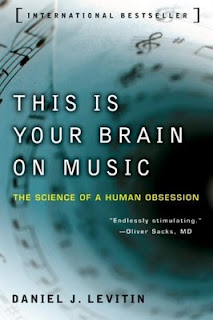
Book Review: This is Your Brain on Music, by Daniel J. Levitin

Before I begin, let me just say right off that I enjoyed reading this book a whole lot and I heartily recommend it. The following harsh criticism is partly because I care enough to wish it was just a bit better, and partly because its subject matter falls in my own general area of expertise (psychology), so I’m bound to be nitpicky.

This is Your Brain on Music explores the science behind music, drawing from the latest research in psychology and neuroscience to explore various facets of creating and listening to it. After reviewing some basic information about music and music theory (most of which was new to me), Levitin begins describing the science behind topics such as categorization of music, the role of emotion in music, and musical expertise.

My first beef with the book is in its accuracy. Vague hypotheses and tentative research findings are often presented as established fact. However, this is to be expected in any science book written for a popular audience (again, me being a nitpicky psychologist). But there are other little errors. Levitin briefly mentions that Canadian psychologist Glenn Schellenberg was an original member of the popular 80s band Martha and the Muffins. However, a bit of Googling reveals that Schellenberg seems to have only played a guest role on a later album of theirs.

This only caught my attention because I’m currently running a study that Schellenberg kindly provided some audio files for. And speaking of name dropping, Levitin devotes many words to telling us how many famous people he has chilled with. At one point, he suddenly goes from talking about the role of the cerebellum in music to an elaborate tale of how he attended conferences with all his scientist heroes and even met Watson and Crick. This autobiographical stuff is interesting enough, but it ruins the flow – the rhythm, if you will – of the scientific stuff when the two are discordantly mashed together.

This haphazard organization is also exemplified in the book’s final chapter. During a discussion of music’s primary role in human evolution that is finally starting to lead somewhere, Levitin suddenly jumps to a vague hypothesis about mirror neurons fueling cultural evolution, then jumps again to a rambling, repetitive paragraph that pretty much says “humans live in groups” 5 times in 5 slightly different ways, and then, the book ends. No real final thought; no paragraph even trying to tie the preceding chapters together, just a random stopping point when he ran out of facts and anecdotes to throw onto the page.

Did I mention I liked this book? While it may be a disorganized collection of facts about music, each fact is fascinating on its own and well worth reading about. We often fail to think very much about the music we listen to for hours each day, and This is Your Brain on music, while it could use improvement, is an eye opening exploration of the deeper layers of the magical human experience that is music.

Side note: In this post, I wondered about the underlying reason for certain musical conventions. For example, why do minor chords sounds sad? Is it arbitrary and cultural? Or is there a more concrete reason? This book answers some of those questions. Long story short, like usual, it’s both. The laws of physics are responsible for some combinations of sounds going well together, but arbitrary choices and conventions also play a large role. E.g., apparently not every culture thinks minor chords sound sad. Interesting stuff.

Love Crime

You know those atheist bus signs in Toronto? Well it looks like someone has vandalized one of them…sorta.

Um. Maybe I’m not fully understanding the author’s intention, but the sign (er, piece of paper) they put on top of the ad really isn’t at odds with the ad. It’s a bit ambiguous, scratching out “prob” and covering “bly no go” with the sign (“there’s a D?”) But the message that love is the most important thing is something most atheists would agree wholeheartedly with. With no supernatural being demanding faith, of course love for others is the most important thing there is. It’s all there is.

Some commenters at BlogTO suggest it’s a hate crime. But it’s more of a love crime. It’s like smashing a church sign then spray painting a cross on it.

Maybe the vandal is just confused. Or maybe it’s deeper; maybe they are pointing out the common belief that atheists, religious folks and The Beatles agree on: all you need is love.

.

.

.

Update: Some have suggested it’s the work of more than one vandal, which would explain a lot.

Book Review: Playing For Keeps, by Mur Lafferty


I love Mur Lafferty. Her podcast, I Should Be Writing, was one of the first I ever downloaded and it hasn’t left my mp3 player(s) since. She’s come a long way, from a self-described “wannabe fiction writer” to full-blown published novelist.

So is she any good at practicing what she preaches?

Let me get the negatives out of the way first. This is Mur’s first novel, published with the small new publisher Swarm Press, and the lack of experience shows. Nearly every chapter is full of one or more typos, grammatical errors, or otherwise awkward prose. Jarring continuity errors crop up (e.g., there is off-hand mention of demons long before they actually show up), and characters often do inexplicably random things. A lack of polish usually doesn’t get in a way of a good story, but here it is so rampant that it can obfuscate the plot and kill any sense of immersion. One careful proof reader could have fixed this. They should hire a teaching assistant, like me; I brutally criticize writing for a living, and do it for almost no money.

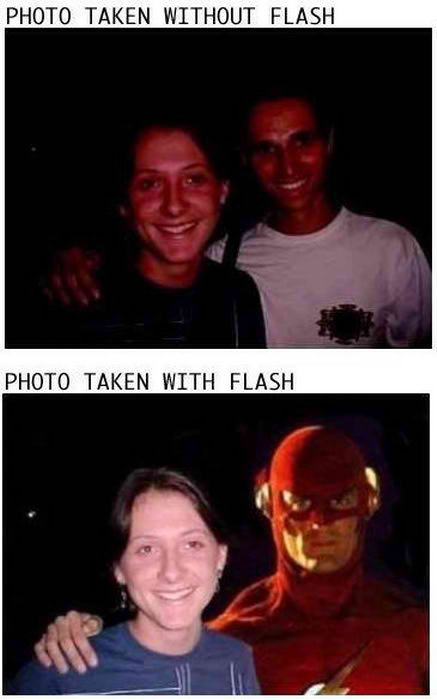
But pushing past technical issues, there is a creative and exciting story here. Playing For Keeps tells the story of the superpowered people between superheroes and supervillains. They’re not good nor evil, just ordinary, and while they can do extraordinary things, their abilities are so specific as to be useless outside of a single purpose (e.g., a cook who can predict anyone’s perfect meal; an old man who can take off and regrow one leg). The highlight of the novel is seeing how, when put to the test, even seemingly shitty powers can be jiggered to do incredible things. The plot moves at a Flash-like pace, with twists and turns happening at the end of nearly every short chapter, making it a quick, fun read that’s hard to put down.

Playing For Keeps is a flawed, awkward mess, but it’s very hard to not have a great time reading it. With unlimited sequel and spinoff potential, and hopefully a bit more time and experience for polishing up future endeavors, I can’t wait to see more from Mur Lafferty and the Playing For Keeps universe.