Fighting Sexism With Sexism in the Horror Genre?

The British Fantasy Society has recently taken criticism because their new collection of 16 interviews with horror authors failed to include any women. It’s pointed out that there are “a lot” of women who write horror, and of course, Mary Shelley’s name comes up.

On the surface it does appear to be blatant sexism. But I think it’s important here, as with many gender issues, to look deeper and make sure we’re not accusing people of sexism based on premises that are themselves fundamentally sexist.

What proportion of horror writers are female? And of those, what proportion are among the best in their field? This list of the top 20 horror writers of all time does not include any women. Maybe its author is himself biased, but there is no question that serious horror (i.e., not Twilight) is a male-dominated community.

Let’s estimate that, say, one out of every ten serious horror writers are female. And let’s say that, for this controversial interview anthology, its creators had to randomly pick from all of the horror authors worthy of inclusion based on their writing alone (i.e., not their gender). The probability of, by chance, picking 16 male authors, then, is (.90)^16 = .185, or 18.5%.

So not a great chance, but still a chance. In the lingo of science, if lack of sexism were the null hypothesis, this wouldn’t be enough to reject it (i.e., prove sexism). My numbers could be off, but I predict my point is valid: even if no sexism were operating and authors were picked from a pool based on merit alone, there is a non-negligible chance that the collection would include zero females.

One could argue that a woman author should have been sought out for inclusion just to represent her gender in the community. But this is itself a sexist premise. It is proposing that a woman should have been given special privilege based on her gender alone, rather than her merit as an author. It’s the same principle behind affirmative action, and in my humble opinion, horribly misguided. It should be self-evident that the key to eliminating sexism is not more sexism.

What is the key? That is a complex question, but I think it needs to start at the bottom. We can’t force the top of any merit-based honour to comprise 50% of each gender. What we can do is make sure there are no obstacles for women on the road to the top, and that safe passage there is based on merit alone. Even more importantly, we can encourage more women to get on that road in the first place if they want to. Even then, there is no guarantee of a 50/50 split – it’s quite possible that horror simply appeals to men more than women because of some genuine difference between the genders – but any women that do hop on board shouldn’t face any sexist roadblocks.

It’s possible that some sexism occurred in this interview collection (either consciously or unconsciously), but there is not enough evidence to convince me either way. I am convinced that writers should be judged based on their writing rather than their gender, and that knee-jerk accusations of sexism need to be carefully examined lest we make the problem even worse.

Book Review: Living Dead in Dallas, by Charlaine Harris

Living Dead in Dallas is the second book in Charlaine Harris’s Sookie Stackhouse series, and the basis for the second season of True Blood. It follows the adventures of Sookie Stackhouse, redneck vampire boinker, as stuff happens to her in her small hometown of Bon Temps, then different stuff happens in the titular Dallas, then in Bon Temps again.

Most of what I said about Dead Until Dark still applies here. Harris’s writing is full of personality and small moments of brilliance that almost make up for the rest of the awkward prose. It’s nice light beach reading, though, because of both the simple writing and the tendency for characters to mindlessly repeat events that just happened (sometimes on the previous page), ensuring that if you get distracted there will always be a “previously on True Bl- Living Dead in Dallas” style review.

The plot is kinda interesting, but I don’t think it’s appropriate to describe this book (or the last one) as a detective story or murder mystery. First of all, there are pretty much two entirely separate stories in the book. The main plot taking place in Dallas has nothing to do with the murder occuring on the first page. Second, the murder plot that bookends the Dallas stuff is only a detective story in the Harry Potter sense: i.e., the main character happens to be around when the rest of the characters spell out the solution to the mystery then proceed to resolve it, but she didn’t do much “detecting” other than knowing where to show up.

I also need to comment on some of the, uh, “character flaws” here. Sookie is a selfish, petty, and manipulative “hero.” Her biggest worries seem to be not about the safety of her loved ones, nor even her own safety, but rather the state of her hair, and whether she is wearing an appropriate outfit or not. Seriously, she cries over messy hair. She is also willfully stupid, specifically refusing to think through actions that destroy others’ lives. Her boyfriend has the excuse of being a vampire, but he’s not entirely innocent either; he’s a bit of an abusive rapist who thinks all problems can be solved with sex, violence, or violent sex. But Sookie seems to fully agree, so maybe it’s a match made in heaven.

Just like the TV show, Living Dead in Dallas is glorious cheesy mess of violence, sex and character drama that, even if not thrown together very tactfully or providing any heartfelt messages about doing the right thing, is damn entertaining. Which is why I will resist the urge to end this review with “hah! More like Living Dead in Dallass“.

Oops.

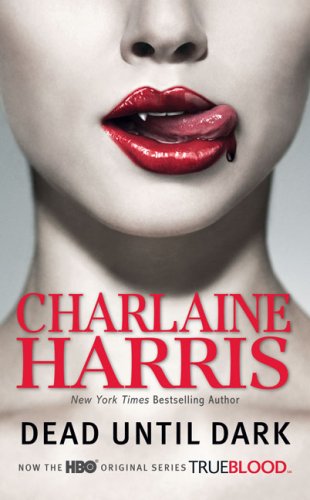
Book Review: Dead Until Dark, by Charlaine Harris

Two of my favourite TV shows ever are Six Feet Under and Buffy the Vampire Slayer. So when I heard that the creator of Six Feet Under was helming a show about vampires, I had to check it out. As predicted, I enjoyed the crap out of True Blood, which lead me to impulsively buy the series of books that it’s based on.

The first book starts off with a great opening line: “I’d been waiting for the vampire for years when he walked into the bar.” Immediately from there, it launches into the story of Sookie Stackhouse, a Southern small-town waitress with two disabilities: the curse of having to read peoples’ minds, and a really stupid name. The first one is what first draws her to the vampire, because she can’t read his mind, which she thinks is awesome because men are scum and they only think terrible things. And although not mentioned, the stupid name problem probably helps her to relate to Bill, which is a pretty dumb name for a vampire. After she meets him, people start dying, hell breaks loose, etc etc. You know the drill.

True Bl Dead Until Dark is written in a first-person style from Sookie’s perspective, and indeed the novel feels like the rambling diary of a realistic, naive young woman who isn’t particularly good at writing, being full of awkward sentences and tactless exposition. This either means: (1) Charlaine Harris is really good at simulating how much Sookie sucks at writing; or (2) Charlaine Harris just sucks at writing.

But let’s just pretend it’s (1) and focus on the positive. Partly because of the informal first-person style, Sookie’s personality comes through, and the little expressions she uses and social conventions she frets over help to bring the Southern setting to life. I could’ve done without her agonizing over what to wear in every single chapter and the sickening mind-games she casually manipulates the males in her life with, but intentional or not, she at least seems like a flawed, real (albeit stereotypically female) person.

There is a murder mystery that ties each chapter together, but the characters seem more interested in short-term questions about cleaning the house, work timetables, and vampire ejaculation than about who’s killing their friends and families. Some chapters can feel separated from the rest of the story, as if nobody remembers what came before. As a single book it’s disjointed, and actually feels a bit like a big pilot episode, with dangling plot elements that exist only to set up future instalments. But since there are plenty of future instalments, and there is a TV series based on it, this episodic storytelling isn’t entirely unwelcome.

The novel departs from the first season of True Blood in quite a few significant ways. Most obvious is the complete lack of Tara in the novel, the alternate reason for Bill’s little trip late in the book, and the ending. There is also one plot element missing from the show, which is a great thing, because it’s extremely dumb. Without giving anything away, it starts with “B”; anyone who’s read it will know what I’m talking about. True Blood also added a few entirely new subplots that I thought worked as well, if not better, than what was from the novel. This gives me hope for the show, because many of the show’s flaws were inherited from the book, and the creators’ willingness to depart from it can only bode well for future seasons.

Perhaps I’ve been a bit snarky in describing Dead Until Dark, but I did enjoy it quite a bit. It’s not a masterfully told story, but it does a few new things with the crowded vampire genre, and has just enough sex and violence to provide some cheap thrills. I recommend it for fans of the show looking to see what inspired it, or anyone else who likes cheesy vampire crap.

The Endless Cycle of Checking Stuff

My use of the internet has reached a critical point. A point where, if I’m not careful, it becomes a self-perpetuating cycle that is nearly impossible to escape.

It used to be, I’d wake up, check my email, respond if needed, then get on with my day. Maybe check my email again an hour or two later.

Now, it’s wake up, check my main email, check Facebook, check Twitter, check Friendfeed, chat on MSN a bit, check Tumblr, check Google Reader, chat on Google Chat a bit, check my other email address, check the news, and oh, it’s been an hour, so there might be something new at my main email. And Facebook. Can’t forget Twitter. Maybe in between, if there’s time, I think of something to blab about on the blog – hi – and then it’s time for the cycle to resume.

Then, oh, whoops, it’s bed time. I’ve been at the computer for 16 hours. And I’ve wet myself.

What I should do is unplug my router. I should turn off my computer. For seriously, what I should do is, I should cut off my electricity and chop up my desk to burn for heat. You know, really get back to the basics and focus on what’s important – family, friends, pets, a good book.

I’ll just check my email one last time.

———-

Edit: In related news, here’s an article on multitasking in Wired Science. It’s interesting, but could also win the award for most blatant contradiction between the headline and the article.

Me, Elsewhere

Oh hi blog. You know you’ll always be my first love, but I’ve been writing stuff in other places too.

  • I have a guest post about horror movies over at The London Free Press’s Dan Brown’s Cool Blog Name to Come. It’s kinda deep. Tell me if you agree / disagree with my little assessment.
  • If you haven’t already listened to my very first musical horror story, Thinking About Polar Bears is here. Reviews are in, and it has been described as “eh,” “okay,” and “I could hardly STAND [it]” (though I think that last one was meant as a compliment). I might put a PDF of it up soon. We’ll see.

I Hope You and This Blog Post “CLICK”

There’s a sign in the bathroom at school that shows a woman holding her hands up, with the areas where bacteria and poop accumulate highlighted on them. Below this, it reads:

Infection prevention is “IN YOUR HANDS.”

I find it hilarious, because like, imagine someone saying this in real life. “Hey, wanna practice safe hand-washing techniques? Well, infection prevention is… look, air quotes… I’m about to make a joke… infection prevention is … IN YOUR HANDS!!!!!! [*holds up hands*] Hahahahahahaha get it? Like, in your hands, your responsibility, but also literally in your hands because it is your hands you are washing. Isn’t that clever?”

It combines the bad idea of using caps-lock for emphasis with the outright mistake of misusing quotation marks for emphasis, all in service of removing all the subtlety from a bad pun. This in a place of higher education.

It reminds me of of this:

It’s a bit more subtle in its punnage, but that tends to make people respond “well actually, blood is in me to keep my internal organs functioning.” So maybe you can’t win either way.

Then again, I’m the only one who thinks about grammar and punctuation this much, so to most people it’s probably all the same.

Algonquin Trip 2009

“I hope something terrible happens that changes our perspective on life forever.”

That’s the tongue in cheek text message I sent to Geoff, the organizer of the canoe trip, the day before we set off. It quickly became apparent that the universe failed to pick up on the sarcasm.

We set out in pouring rain and it hardly stopped during hours of canoeing to a camp site on Tom Thomson Lake in Algonquin Park (about here). The rain soaked through sleeping bags, it created a lake inside our tent, and worst of all, it messed with a medical device that one of us sorta needs to not die. That sent two of our group desperately canoeing away for help before dark fell, while the other two of us stayed to guard the camp and await rescue.

There are some perspective-changing things that go through your mind while lying awake on a cold, wet ground, unsure if your friends are okay and how you’ll get out of the middle of nowhere. Stuff like “I’ll never take for granted how comforting it is just to have telephones around”; “how could I have ever complained about stuff like doing laundry, when I should be happy just to have dry clothes”; “I should just tell people how much I care about them, because life is short.” You know, the usual stuff everyone knows but often doesn’t really feel.

All of us got home safe, a bit earlier than expected but the short time we spent there was an exciting adventure that I’ll never forget. And the thing is, now that I’m back home, maybe I do appreciate being able to crap without a horse-fly biting a chunk of flesh out of my ass, but that stinky damp camp laundry is still sitting there unclean. Which perhaps highlights a defining human trait: adaptability. We can think and do what we need to in order to survive even the most dire circumstances with our physical and mental health intact. But once we’re back in cushy modern life, we go back to taking it for granted and striving for more abstract – and often shallow – goals than mere survival.

Still, I like to think that I’ll appreciate life in civilization just a little bit more than I used to, sweat the small stuff less, and care about what matters more.

Children of the Corn

There’s a commercial for bottled water on TV right now that shows kids frolicking in a swimming pool, and a voiceover goes something like: “your children don’t swim in high fructose corn syrup.”

The conclusion you’re supposed to draw, I guess, is that your kids shouldn’t eat foods with high fructose corn syrup, and should instead drink this particular brand of bottled water.

Here are some other things your children do not swim in:

  • Vegetables
  • Toothpaste
  • Looking both ways when crossing the road
  • Politeness

Yet, in my humble opinion, these should be included in every child’s life.

It’s such a dumb argument that I feel stupider just writing about it. But I’m sure there are millions of people out there who will see the ad and say, “oh golly, that there ad is right huh? My kids don’t swim in corn syrup! And I heard on them there news program that corn syrup is doggone toxic! Honey, can you go down to the store and get some bottl- DAMMIT BRANDON GET OFF THE FUCKING SHED!

Of course, the truth is that high fructose corn syrup is just like any other sugar and is only being used as a villainous contrast to sell a product you get for free out of taps in every modern home. Sorta the opposite of calling something “green.”

In conclusion, when I have kids, I will dunk them in high fructose corn syrup.

Joel Plaskett at Aeolian Hall, July 16th

Joel Plaskett played last week at Aeolian Hall. It was a fantastic show; the dude is ridiculously talented. For the majority of the concert, he played completely solo, just him singing and one of three different guitars.

Aeolian Hall is tiny, so everyone at the sold-out show got good seats. It felt very intimate, with Plaskett telling the stories behind his songs to the rapt audience. When people shouted out requests, he was happy to drop whatever plans he had to accommodate them. This sort of audience interaction, along with some improvisation and alternate versions of his songs, elevated the show way above a live rendition of his albums.

For me, music is all about emotion, and Plaskett really gives the impression that he is feeling what he’s singing.

He was joined by Peter Elkas for several portions of the show. I gotta admit, I’d never heard of him before last night (though he seemed vaguely familiar), but he was a great compliment to Plaskett’s music and humour.

The dudes even stayed around after the show to sign stuff and chat with fans. I shook Joel’s hand! OMG! But anyway, I highly recommend seeing Joel Plaskett live if given the chance. Best show I’ve seen in a long time.

Oh and I managed to win two tickets to another show at the Hall in August, because I am very skilled at winning random draws. Who wants to be my date?

The Emotion of WTF

WTF should be an emotion. There isn’t yet a single word for the sense of seeing something that totally boggles the mind; it’s related to confusion, but not the same thing. Confusion is aversive, while WTF leads to LOLs and a state of blissful unawareness of what’s going on. It’s more like confusion feeding into a jolt of happy surprise.

The Dadaists and surrealists didn’t quite have a name for it either, but they certainly understood WTF. While they wrapped their work up in a philosophical movement and reaction to existing art, it would never have caught on if people didn’t have an inborn love for the non-sequitur.

Many artists get their inspiration from dreams, and dreams illustrate that we all have nightly encounters with WTF. When left to their own devices, our brains rejoice in the random. We’re built to like it, and I suspect this serves an evolutionary purpose. Love for the outlandishly mysterious is part of the same drive that allowed early humans to figure out why the clashing rocks and the sparks and the fire always went together. It’s the same stuff that fuels science today.

We must celebrate the random. Bathe ourselves in nonsense. WTF.

Some more pictures from the internet’s leading source of WTF, Picture is Unrelated: