Beer : Statistics :: Peas : Carrots

I once got slightly intoxicated while “studying” the night before a major exam in statistics. Normally this would not be something to be proud of, but the fact is, despite the morning headache, my mind was clear of distractions and all that wonderful statistical knowledge flowed onto the paper just as smoothly as the beer flowed into my belly the night before. I aced the exam and secured my future in psychology. (This is a story that Nick likes to tell whenever someone mentions exams and drinking in the same sentence).

It turns out there is a very good reason that beer and statistics go together like birds of a feather. The study of statistics has been linked with beer since its early history. Anyone with basic stats knowledge has heard of Student’s t-distribution, often used to tell if two groups are different from each other on some measure. Student was the pen name of William Sealy Gosset, a statistician working in Dublin. The dude chummed with some of the more familiar names in stats, like Pearson and Fisher.

The thing is, Gosset didn’t give a crap about discovering the inner workings of the mind by poking and prodding samples of unsuspecting humans. No, Gosset just wanted to use mathematics to brew tasty beer. He worked for the Guinness brewery, applying statistical knowledge to growing and brewing barley. Guinness wanted to protect this powerful secret knowledge from competitors, so Gosset was forced to publish under a fake name, and apparently more math-creative than naming-creative, chose the name “Student.”

So that’s how Student’s t-distribution was born. And that’s why having a few pints of Guinness before a major stats exam should be encouraged. Even if it results in failure – and very well might – mention to the prof that it was a tribute to the long and fascinating history of beer and statistics. That’s gotta be worth a few bonus marks.

…..

P. S. I hope you noticed the subtle normal curve in the picture of the Guinness up there. That took some serious Photoshop skills you know.

Get Smart

Wired Magazine has just put up a set of articles on the topic of intelligence: Get Smarter: 12 Hacks That Will Amp Up Your Brainpower.

It’s partly just a movie promotion (for the Steve Carell remake of Get Smart. Get it?), and a lot of it is oversimplified or just plain wrong, but there is some interesting stuff in there that’s worth thinking about as long as you have a few grains of salt at the ready.

One thing I found particularly interesting is the person who tried maximizing their time by cutting down on sleeping. As I’ve long maintained, sleep sucks. For the most part, it’s a waste of time. Unfortunately, it didn’t seem to work for this person, who tried altering their sleeping pattern such that they had short naps throughout the day but less overall sleeping time. They felt crappy all the time. Bummer. I’m still waiting for that anti-sleeping pill with no side effects. Get on it, science!

Book Review: Haunted, by Chuck Palahniuk


In Chuck Palahniuk’s world, nothing is what it seems. Something sinister lurks behind the scenes of everything ordinary. Homelessness, feng shui, those dolls you practice CPR on, talk shows; they’re not what they seem to be. It’s an interesting place to visit, but you wouldn’t wanna live there. That’s what makes Haunted – a collection of bite-size chunks of story – such a perfect window into Chuck Palahniuk’s world.

Haunted squishes together short stories, poems, and a novel in a semi-coherent fashion. There is an overarching story, but it’s really not the main attraction. It’s the short stories, presented as if they were written by the characters in the main story, that really shine here; and by “shine”, I mean “make you gasp, barf, and possibly faint.” They’re horrific, but for the most part, not in a supernatural way; this is all real-world horror. Palahniuk claims that many of them are true. At the same time, though, they are so over the top that they must be exaggerated beyond recognition. At least, that’s what you gotta tell yourself, because like I said, Chuck Palahniuk’s world is not the one you want to be living in.

He ends the book with an autobiographical story about the power of books, and their freedom and necessity in a world of mass media. It’s both inspirational and frightening. If you are looking for a book that can affect you in ways that television and movies never do – though not always in a good way – then look no further than Haunted.

Donate Your Useless HBC Rewards Points to The Humane Society

Willow is over today, which got me thinking about how to do nice stuff for dogs, so I went over to The London Humane Society‘s web site and discovered something awesome.

You can donate to The London Human Society with HBC Rewards points. To any individual person, these things are useless anyway. I’ve had my HBC card since long before it switched from being “Club Z”. Yet, in 10-15 years of occasional shopping at Zellers and hundreds of dollars spent on Mac makeup at The Bay (as gifts for girls of course….yes…gifts), here is the complete list of wonderful rewards I could obtain:

Yay?

So screw that. My points are useless to me. With lots of people donating their points to the Humane Society, though, they add up and can probably net some stuff that’s actually useful. Stuff that could improve or save an animal’s life. You can donate any percentage of points you want, and you can do it all online right here. If you’re not in London, you can donate to your local humane society. (I’m seeing mostly Canada on there, but you people in the US probably don’t know what the hell HBC is and stopped reading two paragraphs ago anyway).

Unfortunately, you can’t donate points already earned. To keep them from going to waste, then, I’d better order that magazine holder. It’d go good beside the toilet for some bathroom reading. I’ve never understood that, since I eat lots of fiber, but maybe guests would enjoy it, and the faux leather would certainly spruce up the bathroom’s style.

But seriously, dear blog (and Facebook) readers…though I hate being preachy, this is something that can do some good for virtually no effort.

Publish and Perish

Not to not brag or nothin’, but you are now a friend/acquaintance/worshiper of a published scientific researcher. My first publication finally popped up on the internet recently (even though it was apparently published in 2007, the journal seems to be running behind or something).

Here is the full reference:
Sorrentino, R. M., Seligman, C., & Battista, M. E. (2007). Optimal distinctiveness, values, and uncertainty orientation: Individual differences on perceptions of self and group identity. Self and Identity, 6, 322-339.

If you’re subscribed through your university (or wherever), you can find the article here, at your local library, or through Google. That’s right, I’m Googlable.

Optimal distinctiveness refers to the fact that people don’t like to feel too different from other people, but also don’t like to feel too similar. However, this is true for some people more than others. We found that people who prefer certainty to uncertainty also tend to try thinking of themselves as similar to other people after being made to feel different. In other words, these certainty oriented people tend to want to assimilate back into a crowd when they feel like they are weirdos who don’t fit in.

We proved this with advanced science. Here is some science from the article:

Those are graphs and formulas formulae. It doesn’t get much more scientific than that.

I do find it strange that this article costs $43.75 to purchase without a subscription. That’s more than most books, just for one article that is, no offense to the authors (none taken), not all that exciting. What’s strangest, though, is that I don’t get a dime of that. Musicians complain that record companies take a large percentage of the profit from record sales. With us, publishers take 100%.

Plus, isn’t science supposed to be free, open, and collaborative?

Oh well. Luckily, with the internet, it’s nearly free to distribute a file containing a research article, and many researchers make their own work available free of charge on their personal web sites. Hey, maybe I should do that. I will soon. You just stay tuned.

Anyway, I’m done bragging / feeling sorry for my broke self.

See also: Optimal Distinctiveness Theory on Wikipedia. Oh look, there’s our article! How did that get there? *WINKY FACE*

A Skeptical Look at Yogurt

I hate yogurt commercials. I’m not a big fan of yogurt itself either, aside from it being one of the funniest-sounding words in the English language. Yet, the other day, I went to pick up some groceries, I was really hungry, I wanted something healthy, and I was in a hurry, so some sort of implicit association kicked in and I got some Activia yogurt.

There are a bunch of buzz words associated with yogurt like Activa that they blab about in the commercials, calling it pre-biotic, pro-biotic, mo’ biotic, whatever. I decided to look into what this actually means.

The horrible commercials clearly imply that eating this bacteria-infested yogurt will help you lose weight. In one of them, two people are sitting down in workout clothing talking about yogurt. One of them has sciency-looking animations orbiting around her skinny belly. As if sitting there eating yogurt is the equivalent of a full workout, infusing science into your belly and melting away fat. The commercial asks you to take the “14 day challenge” (*). What are you challenged to do? Well, buy lots of yogurt and chow down for 2 weeks, of course!

Let’s go to their web site to see how they back up their claims. Ahh, ok, so probiotic cultures are literally little living organisms that survive in your gut after you swallow them. Gross…but I guess we always have living beasties in there anyway. But how do the magical health benefits work? Oh, here we go:

Oookay. So it works by, um, working. Then something about balance.

Oh look! A hot chick in a lab coat! Perhaps she can tell us more.
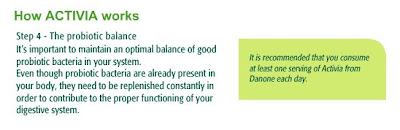
Ok, so we need some of these bacteria. Of course, it doesn’t actually say that eating this yogurt is the only source of them. Or a good source. The leap to eating it every single day might be a bit of a stretch.

But what do they actually do? Does having lots of these bugs in your gut help you lose weight like the ads imply? Let’s go to the section devoted to information on probiotic cultures. Oh, look, they link to an external web site all about them – www.probiotic.ca – to learn more. A third party must be a legitimate source of information, since they won’t fabricate hard scientific data just to sell more yogurt.

Now, I’m not making this up; here is the sole source of information on probiotic.ca:

Seriously. The only working link is “watch.” If you do, it’s a disturbing video with smiling animated bacteria worming their way around the human digestive system.

Here they are packing their bags and leaving out of someone’s anus, along with a giant turd. Again, I’m not making this up.

Oh, and look who owns that web site. Danone. Makers of Activia. So it’s basically the world’s most ineffective propaganda video.

Back to Danone’s main site. Here is what they claim the point of eating Activia is:

Why is Activia® yogurt such a great choice?

* It is the only yogurt to contain unique BL RegularisTM specifically selected by Danone researchers.
* BL RegularisTM is scientifically proven and clinically tested to survive passage through the digestive system, arriving into the large intestine as a live culture that stays active.
* Activia® can truly be called a “yogurt with an active probiotic culture” because of the unique, additional friendly bacteria it contains: BL RegularisTM.
* It tastes great – consumers ranked Activia® highest among yogurts for flavour and creaminess in Danone taste tests! (Source: Cintech, July 2003)
* It is available in twelve delicious flavours.

To sum up: It tastes good, and it puts living organisms in your belly. Hey, neat, but I could replace “BL RegularisTM” with “dirt”, and it really wouldn’t be any more or less convincing. Wow, it’s the only yogurt with dirt, it maintains its pebbly nature in the digestive system, and tastes great! Uh, so what?

There’s still no mention of weight loss here. No mention of any benefits at all.

Let’s just go to the “Scientific Proof” section. Finally, we get to a small handful of actual scientific studies done on this stuff. The main conclusion? It helps old people and people with intestinal problems have reduced “intestinal travel time.” In other words, if you have trouble shitting regularly, it will help you shit.

Nothing about weight loss. And more importantly, regarding normal people, I quote, “In subjects with a normal transit time, no marked change or risk of diarrhea was observed.” Note: no marked change.

The bottom line is, unless you are having bowel problems, it won’t do anything. If you are, it might make you more regular. And it probably won’t give you diarrhea.

I guess all the stupidness of the commercials and the vague claims on the web site make sense now. They were dancing around the fact that all these fancy words really don’t mean much. And “it probably won’t give you diarrhea” wasn’t a very catchy slogan.

Perhaps I’m being too hard on this stuff. It actually does taste pretty good, and even if it has no special benefits, all yogurts are healthy low-calorie foods in general. But I see no reason to go out of my way to get yogurt specifically because it has probiotic cultures in it, nor to pay more for it. Also, it is downright deceptive to clearly imply that the stuff helps with weight loss, when no such benefit has been demonstrated. Danone can take their bacteria and shove them back up their extremely regular asses.


Footnotes:

(*) Of course, the yogurt expires before the 14 days are up, so you gotta have more than one per day, share some, or waste some and buy another pack in 10 days.

Oh, but if you need help with the challenge, there’s another web site for that:

Do we really need a support group to eat a cup of yogurt?

Arthur C. Clarke, RIP


Arthur C. Clarke died today (*). The man was a genius. I’ve only recently started reading his books, but his impact has been felt throughout my life. Nearly every piece of science fiction created since the 50s owes something to Clarke. More directly, seeing 2001: A Space Odyssey as a kid, even though I didn’t fully understand it at the time, probably had quite the impact on me. It’s a testament to human curiosity about life’s most perplexing questions, and the fact that there is more to life than this earthly existence, with no need to invoke the supernatural to appreciate it. Perhaps this was part of what sparked my interest in science.

Speaking of which, anybody interested in science should take note of Clarke’s laws of prediction:

  • 1. When a distinguished but elderly scientist states that something is possible, he is almost certainly right. When he states that something is impossible, he is very probably wrong.
  • 2. The only way of discovering the limits of the possible is to venture a little way past them into the impossible.
  • 3. Any sufficiently advanced technology is indistinguishable from magic.

There’s a lot to take out of those three little statements. But I think the main message is one of hope rather than cynicism. What seems impossible may very well be possible; what we consider magic today may be within our reach tomorrow.

Even though it’s impossible, let’s hope Clarke is now a glowing fetus looking down on us from a bubble floating in space. Float in peace, Arthur C. Clarke.

.

.

* Actually, he died tomorrow, since he was in Sri Lanka, where it’s already Wednesday.

Book Review: Stumbling on Happiness, by Daniel Gilbert


As anyone who has studied any psychology knows, humans have one of the most advanced brains out of all the animals on this planet, but they’re far from perfect. There are a lot of situations in which our brains make minor mistakes, and some situations in which they outright betray us. Stumbling on Happiness is an overview of many of these mistakes, with a special focus on mistakes we make when we remember how we felt in our past, or try to predict how we’ll feel in the future.

The book is extremely easy to read. It’s often hilarious, and not just in a “I’m a clever scientist so I’ll throw in a reference to some obscure work of literature and everyone will laugh” sort of funny, but actually hilarious. It also stays clear of any psychology jargon or statistics. As someone studying psychology, I could complain that he oversimplifies things sometimes (for example, discussing the theory of cognitive dissonance without ever calling it by name), but really, the book isn’t meant for psychologists. Anyone could read this and learn a lot about how the mind works, then go read the original research for the details. And even though I don’t fully agree with every conclusion he reaches, I’m glad he never simplifies to the point of being dishonest (like some popular psychology books are prone to doing), such as offering an easy answer to eternal happiness. In science, and especially in psychology, there are no easy answers.

A caution though: the book is more about stumbling, less about happiness. As Gilbert clearly states at the beginning, this isn’t a book about how to make you happy. It’s about how you often suck at predicting what your future will be like, and that happens to include how happy you’ll be. This book can teach you a bit about human psychology, but it cannot teach you how to be happy. He does give one scientifically verified suggestion for how to predict your own happiness, but you won’t like it.

I really enjoyed reading Stumbling on Happiness. Or at least, I currently think I enjoyed it. My brain may not be entirely accurate when retrieving my past happiness while I read it. But I’m pretty sure that anyone interested in psychology could amplify their own future happiness by picking up this book.

Book Review: The Singularity is Near, by Ray Kurzweil

The singularity refers to a time, sometime in the future, when machines become more intelligent than biological humans, and technology begins to improve rapidly as a result. The Singularity is Near is Ray Kurzweil’s attempt to justify his belief that the singularity is coming sooner than most people think, and what consequences it will have.

Oh, what consequences.

Kurzweil envisions a future where almost nothing is impossible. Human-machine hybrids live forever in a world with very few problems, playing and engaging in intellectual pursuits in any virtual reality environment they can imagine. This isn’t your typical flying-car future. What use are flying cars when anybody can instantly obtain any information, or experience any location, just by thinking about it? It sounds like science fiction, but Kurzweil convincingly argues that it is not fiction at all.

The best part is that, if he’s right, almost everyone reading this can experience this future in their lifetime. This book should be prescribed to suicide-prone people. With a Utopian future just a few years off, why end it now?

Some would probably argue that Kurzweil is too hopeful. He does seem a little, uh, off at times. The dude is on a radical diet involving dozens of drugs and food restrictions, just so his aging body can last long enough to see the singularity he so believes in. And how many times do we need to be reminded that in the future, you can become the opposite gender and have sex with whoever, or whatever, you want? That’s cool if you’re into it, but in a world with almost no limits, I think most people will come up with even more interesting stuff to do with their time. And although he argues each point well, if he’s wrong about even one – for example, one fundamental limit on technology is reached, or one catastrophic world-altering event sets us back – all his predictions could fall apart.

Still, even a small chance that he’s right should give us all an enthusiastic hope for the future. Reading this book (and its shorter predecessor, The Age of Spiritual Machines) made me happy to be alive in today’s world; I don’t think I could give a book any higher a recommendation than that.

P.S. I wrote more about this book at this post. Yes, it took me more than 6 months to read it. In fact, it probably took me over a year. It’s damn thick. But although it does have boring bits, it’s worth the time investment.

Phenomenon

I watched this new show called Phenomenon on Wednesday. Basically, it’s American Idol with magicians (mentalists, to be specific). Criss Angel plays the part of Simon Cowell, and Uri Geller plays the part of Paula Abdul.

First of all, I loved the show. It’s all done live (supposedly), which gives it a realistic feeling that you don’t get with a lot of modern magic on TV (e.g., Mindfreak or David Blaine’s specials). The guy with the nailgun was particularly intense; you know he probably won’t screw it up, but just knowing there’s a small chance he’ll puncture his brain on live television is enough to keep it interesting. The bear trap guy was less impressive. Dude, you didn’t even hide the fact that you switched the trap. And are you in pain or not? At least keep your act consistent.

But there is a degree of confusion in this show that sorta pisses me off. On one hand, there’s Uri Geller there, who claims to have “real” psychic abilities. In the introductions to the contestants, some of them told stories about sensing the death of a loved one, or whatever. The show seems to foster the belief that these people really do read minds.

On the other hand, Criss Angel is there. I think Criss Angel is awesome. If you watch carefully, you see that his approach is actually quite skeptical. On his show, he sometimes reveals how he did his tricks. He refers to his feats as “illusions” or “demonstrations”, and never claims to have any supernatural abilities. I think this was epitomized in one episode of Mindfreak, when he spent the entire episode putting on a seance and freaking people out by having them see and feel ghosts. At the very end of the show, he said something like “so do you believe in ghosts now? I don’t.” Nice. On Phenomenon, these people are illusionists; what they do is amazing, but not supernatural. They can make it look like they are reading minds, but they are not. It’s awe-inspiring in a similar manner to really good special effects in a movie. You almost believe it’s real, but you know it’s not.

Phenomenon can’t decide if it’s trying to amaze us by tricking us into thinking it’s real, or by showing us really good performances by people who we know are trying to trick us. Now, you know I’m not one to completely dismiss psychic phenomena. There’s something to them, and they’re worth researching scientifically. But nobody in their right mind is going to believe that flawless mindreading is going to happen on a reality show (nor any other silly game). I’d be more impressed if the show was up front about that.

My guess is that Uri Geller prevents it. He wants people to believe that stage magic is a genuine demonstration of psychic abilities, so that his own stage magic thrives. The dude does some impressive stuff, but come on, he can’t really bend spoons with his mind. Again, with him, I’d be more impressed if he didn’t put on the whole “everything I do is because I’m actually psychic” act. He did a demonstration of his “abilities” live on the show, by having the audience choose a symbol (one of the five Zener card symbols) that he had sealed in an envelope. It just barely worked out – and hey Uri, any chance you always pick the star in demonstrations like this? How about randomly selecting the symbol next time?

Anyway, like I said, loved the show, but I do wish it wouldn’t perpetuate the myth that stage mentalism and “real” paranormal phenomena are the same, or even related. I have a long standing interest in both, but they are completely separate things.

Bonus fact: Uri Geller designed the logo for *N Sync. It must have taken all his psychic energy to conjure up a star to put in front of the band’s name. Oh hey! Maybe it’s related to the fact that most people out of any randomly selected group will choose a star over other symbols. Well played, Uri.