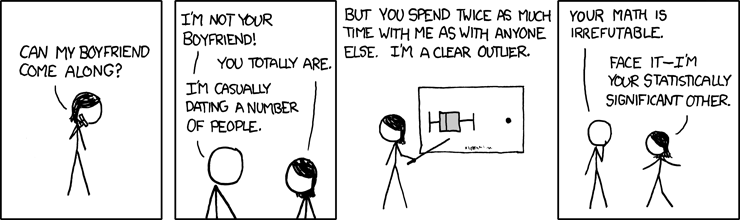
(from xkcd)

(from xkcd)
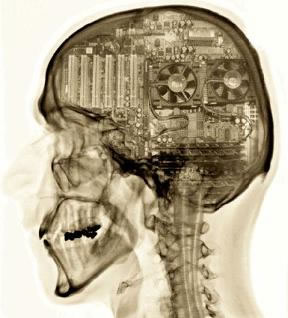 This fascinating article at Scientific American, about human and animal consciousness, contains the following passage:
In humans, the short-term storage of symbolic information—as when you enter an acquaintance’s phone number into your iPhone’s memory—is associated with conscious processing.
A few years ago, when I was first learning about memory, the example probably would have gone more like “your short term memory holds small amounts of information, like a phone number, while you rehearse it in your head until you have it memorized.”
The main difference between the examples is that the iPhone has replaced our own biological memory storage as the final resting place of long term memories. I think this points toward a more general trend, in which technology is taking over many of the functions that our brains carried out before. Why memorize a phone number when you can, at any time, just retrieve it on a screen with a few swipes of your finger? Why commit the times table to memory when a calculator is always close at hand?
Storing memories outside of our brains is nothing new. Scrawling something on paper is much the same. However, the ease with which we can store and retrieve these external memory banks is improving at an exponential rate. Today, a lot of the human race’s collective store of knowledge can be searched in fractions of a second with a few keystrokes in a search engine. Maybe tomorrow, our fingers won’t even be an intermediary step; a direct link between our minds and databases need not be science fiction. Google may not just be the future of computers, but the future of the human race.
As we continue to improve our access to information outside of our heads, I think there will be less emphasis on teaching people raw information, and more emphasis on teaching what to do with information. [self plug] Scientific research into topics like human creativity (which computers don’t seem to have mastered yet) and cognitive psychology will become increasingly important [/self plug], as will disciplines like philosophy and math, which deal purely with how to manipulate information into something useful. We should probably also keep Keanu Reeves around to make sure we haven’t slipped into The Matrix without realizing it.
Christof Koch (2009). Exploring Consciousness Through the Study of Bees Scientific American
 In Snuff, Chuck Palahniuk takes on the world of porn. It’s not like this is a big departure from his previous material (see my reviews for Invisible Monsters and Haunted), so he’s right at home here. Snuff tells the story of an aging porn star who sets out to break the world gangbang record; 600 dudes in a row.
It’s typical Palahniuk, with troubled characters, gross-out moments, shocking twists, “true facts” that may or may not be true, etc. It’s a much simpler story than some of his others, feeling more like an extended, shallow short story than a complete novel, but it’s an entertaining quick read for any fans of his previous work.
Snuff also has the best collection of porn movie titles I’ve seen. World Whore Three: The Whore to End All Whores is just the beginning.
Palahniuk’s style does get a little grating after reading several of his books. Characters in his stories never really have conversations; they just talk to themselves while in close proximity. Sure, they’re all a bit fucked up, but it would be nice if, just once in a while, characters actually responded to one another like normal people.
Also: I’ll be happy if I don’t have to read the words “shared meatloaf” ever again.
I am of the firm opinion that the zombie walk phenomenon is the best thing to ever happen to the world. I’m so glad that London has one every year now. I managed to make it out yesterday, albeit as a puny human and not a zombie. Here are some pictures.


I love how every zombie had some twist or detail that made them unique. The girl above has a pencil sticking out of her neck, and that guy held the severed hand in his mouth the entire time.


The makeup on the one above was amazing. Every time I see a girl dressed as a zombie, part of me falls deeply in love.

I’m not a photographer and my pictures aren’t the best. Check the London zombie walk’s official site and the event’s Facebook page for better professional-type pictures.
I love this one that someone else took:

And here’s a closeup of that amazing makeup:

I so wanna participate next year.
One of London’s oldest bars, The Wick, was secretly smashed with a wrecking ball on Sunday. The whole situation is extremely sketchy. The demolition started just before a meeting planned to discuss the building’s future as a protected heritage site. It was so rushed that utilities weren’t even shut off, and there was still beer inside. It was left half-destroyed, with debris falling to the unprotected street below.
I’ve only been to the Wick a few times, but I’ve always had a great time there. It catered to a different crowd than the Richmond Row university types (e.g., not many places would feature Dennis Humble). I am sad to see The Wick die just as I was getting to know it.
I have no problem with the owner of the building tearing it down if that’s what they need/want to do. But it didn’t have to be done so sketchily. They could have at least waited until its status as a historical building was decided upon; if it was really just a useless old building, as many maintain, then fine, tear it down a few days later.
But dude, look at this:

I’m not sure when this map of London is from, but there’s the Wick with its own stables, nestled among mills and carriage factories. I don’t know if that sort of history is worth taxpayer dollars to preserve, but it does make its eradication all the more tragic.
People say the place was an eyesore. What? I took this picture yesterday, after someone painted “save me” on the side, but it just looks like any other old building in London.

Of course, now the backside isn’t looking so hot.

I’m sure the owner has their own reasons for tearing it down. I do find it troubling that many Londoners support the move, though. Perhaps it is some implicit bias against the non-clean-cut image that the Wick and its patrons project. But screw that. I’d rather see 50 more places like the Wick than another bar pretending it’s in a bigger city, or some squeaky clean clothing store that tries really hard to be cool, or whatever.
Oh well. All this sketchiness does make for an interesting story.
Saw this on a post along the Thames today:

Weird/cute/sad.

Ok so go read this review of Nick and Norah’s Infinite Playlist by critic Jordan Hiller and then come back here.
Since you totally didn’t read it, here’s a summarizing quote:
The film and those like it are merely the reflection of ageing creative people in hopeless search for an elixir.
I haven’t seen the movie, but I do find this review pretty ironic. Most of it attacks the movie because its portrayal of teenage life is not realistic, is just a cheap attempt by its creators to hold onto their own youth, and was created to tap into the conflict between youth and adulthood that everyone struggles with throughout their lives.
The irony comes from the fact that the reviewer compares the movie with what I assume are the teen movies of his own youth in the 80s. Again, maybe the movie really is crap, but is comparing it unfavourably to one’s own favourite nostalgia-enhanced movies while at the same time dumping on nostalgia really a good way to criticize it?
He does make a good point that movies are not realistic, and present an idealized reality that may only be an attempt to cash in on our obsession with youth. But is that a bad thing? Writers can deal with their own youth / responsibility struggles by creating fantasy, and people can relate with that fantasy when they see it put to film. The search for an elixir of life isn’t hopeless; we can take tiny sips of it for two hours at a time every time we watch a good movie.
Additional thoughts:


– Wasting an extra 2 hours out of every 24 means that waking time for each day is reduced by about 8.3%
– People in Canada live to about 80. To extend that by 8.3% would mean living to almost 87.
– Can sleeping 9 hours a night extend one’s life expectancy to 87? I doubt it. And even if it did, I’d rather be enjoying waking hours while I’m young and virile than while I’m old and fragile. Screw sleep.


Bret Easton Ellis’s American Psycho describes a few years in the life of Patrick Bateman, a successful investor and psychopath. That’s about all there is to it.
American Psycho is not so much a story, but a drawn out snapshot of the nightmare world of yuppies in late 80s New York. This setting is as much of a character as Patrick Bateman is (the first third of the book is purely about his everyday life in this world, and we only later get a glimpse into the “psycho” part of it). I think that it’s not so much that this world created the monster that is Patrick Bateman (the only description of his father is something like “there is something wrong with his eyes”, implying that his psychosis has pretty deep roots), but that this world allows him to exist. Everyone is so self-centered and focused on superficial crap that they don’t notice the serial killer in front of their noses. In a way, many of the characters in the book are as inhuman as Bateman is.
This is not a straightforward novel; it is very much open to interpretation in both its narrative and its message. Both the matter-of-factly described scenes of brutal violence and the overly detailed descriptions of fashion and music often had me wondering why the hell I kept reading it. But I did keep reading, and while it may not be an entertaining novel in the traditional sense, it did make me think. And it made me want to go out to a cheap restaurant where I don’t need a reservation and make real connections with people, because dude, the world depicted in American Psycho is a shitty place that should be avoided at all costs.
I have to go return some videotapes.
I love Google’s title image for today:

It’s a nice mix of recognizing an extremely important scientific accomplishment with just a pinch of end-of-the-world paranoia.
The truth is that the world has about the same chance of ending today as it did yesterday. But I think the dimwitted people protesting the large hadron collider aren’t all bad. It’s seriously nice to be reminded that the world could end at any moment. All of human history is just a brief blip in time on a cosmic scale; it could end right now and the universe would barely notice. But the thing is, in a universe with a past almost completely devoid of our existence, and a future that could very easily be the same, all we’ve got are our short little lives here in the present.
The fact that the universe is vast, cold, and uncaring does not make our lives meaningless. It’s the opposite; it shows that we are the exception rather than the rule, so we damn well better take advantage of this fleeting gift and make our lives mean something. It also makes it all the more incredible that we are on our way to understanding this vast, cold, and uncaring universe with technology like the LHC. Even if it did end human existence, at least we went out trying to understand our place in the universe. And with a good excuse to have sex.

(xkcd rules)
 Mike Battista's Blog