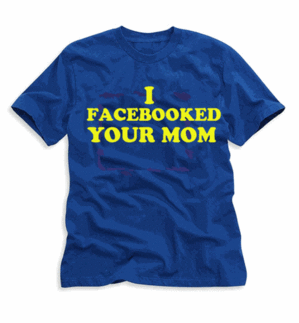
You Don’t Write on Your Own Facebook Wall

A peculiar fact about Facebook is that you are not supposed to write on your own wall. Because that really could have gone either way, eh? With blogs, conversations take place on a single blog, often with the blog’s owner commenting on his or her own blog. It has the advantage of the entire conversation being in one place. But a disadvantage is that anyone who comments on a blog will have to go back to that blog to see if anyone responded to it.

What I wonder is who decided that posting on your own blog is OK, but posting on your own Facebook profile is not. Was it one person who persuasively argued for a position? (e.g., I’ve seen it argued that posting on your own wall is like leaving a note on your own fridge and hoping your friends will stop by to read it) Or did it just happen naturally due to subtle properties of Facebook that make having conversations between walls easier than having them on a single wall? Or was it completely arbitrary, with one position that just happened to spread around and eventually became codified as a new taboo?

It makes you wonder if other taboos develop in similar ways. Like, who decided it was wrong to wear a hat at dinner time? I’m sure there was a good reason for it at one point, but now, I see no reason why having a piece of cloth on your head disrupts a meal.

Of course, a good source of LOLs is breaking taboos, so I’m gonna go write inane messages to friends on my own Facebook wall while I eat pizza in a cowboy hat.

Book Review: Haunted, by Chuck Palahniuk


In Chuck Palahniuk’s world, nothing is what it seems. Something sinister lurks behind the scenes of everything ordinary. Homelessness, feng shui, those dolls you practice CPR on, talk shows; they’re not what they seem to be. It’s an interesting place to visit, but you wouldn’t wanna live there. That’s what makes Haunted – a collection of bite-size chunks of story – such a perfect window into Chuck Palahniuk’s world.

Haunted squishes together short stories, poems, and a novel in a semi-coherent fashion. There is an overarching story, but it’s really not the main attraction. It’s the short stories, presented as if they were written by the characters in the main story, that really shine here; and by “shine”, I mean “make you gasp, barf, and possibly faint.” They’re horrific, but for the most part, not in a supernatural way; this is all real-world horror. Palahniuk claims that many of them are true. At the same time, though, they are so over the top that they must be exaggerated beyond recognition. At least, that’s what you gotta tell yourself, because like I said, Chuck Palahniuk’s world is not the one you want to be living in.

He ends the book with an autobiographical story about the power of books, and their freedom and necessity in a world of mass media. It’s both inspirational and frightening. If you are looking for a book that can affect you in ways that television and movies never do – though not always in a good way – then look no further than Haunted.

Arthur C. Clarke, RIP


Arthur C. Clarke died today (*). The man was a genius. I’ve only recently started reading his books, but his impact has been felt throughout my life. Nearly every piece of science fiction created since the 50s owes something to Clarke. More directly, seeing 2001: A Space Odyssey as a kid, even though I didn’t fully understand it at the time, probably had quite the impact on me. It’s a testament to human curiosity about life’s most perplexing questions, and the fact that there is more to life than this earthly existence, with no need to invoke the supernatural to appreciate it. Perhaps this was part of what sparked my interest in science.

Speaking of which, anybody interested in science should take note of Clarke’s laws of prediction:

  • 1. When a distinguished but elderly scientist states that something is possible, he is almost certainly right. When he states that something is impossible, he is very probably wrong.
  • 2. The only way of discovering the limits of the possible is to venture a little way past them into the impossible.
  • 3. Any sufficiently advanced technology is indistinguishable from magic.

There’s a lot to take out of those three little statements. But I think the main message is one of hope rather than cynicism. What seems impossible may very well be possible; what we consider magic today may be within our reach tomorrow.

Even though it’s impossible, let’s hope Clarke is now a glowing fetus looking down on us from a bubble floating in space. Float in peace, Arthur C. Clarke.

.

.

* Actually, he died tomorrow, since he was in Sri Lanka, where it’s already Wednesday.

Phenomenon

I watched this new show called Phenomenon on Wednesday. Basically, it’s American Idol with magicians (mentalists, to be specific). Criss Angel plays the part of Simon Cowell, and Uri Geller plays the part of Paula Abdul.

First of all, I loved the show. It’s all done live (supposedly), which gives it a realistic feeling that you don’t get with a lot of modern magic on TV (e.g., Mindfreak or David Blaine’s specials). The guy with the nailgun was particularly intense; you know he probably won’t screw it up, but just knowing there’s a small chance he’ll puncture his brain on live television is enough to keep it interesting. The bear trap guy was less impressive. Dude, you didn’t even hide the fact that you switched the trap. And are you in pain or not? At least keep your act consistent.

But there is a degree of confusion in this show that sorta pisses me off. On one hand, there’s Uri Geller there, who claims to have “real” psychic abilities. In the introductions to the contestants, some of them told stories about sensing the death of a loved one, or whatever. The show seems to foster the belief that these people really do read minds.

On the other hand, Criss Angel is there. I think Criss Angel is awesome. If you watch carefully, you see that his approach is actually quite skeptical. On his show, he sometimes reveals how he did his tricks. He refers to his feats as “illusions” or “demonstrations”, and never claims to have any supernatural abilities. I think this was epitomized in one episode of Mindfreak, when he spent the entire episode putting on a seance and freaking people out by having them see and feel ghosts. At the very end of the show, he said something like “so do you believe in ghosts now? I don’t.” Nice. On Phenomenon, these people are illusionists; what they do is amazing, but not supernatural. They can make it look like they are reading minds, but they are not. It’s awe-inspiring in a similar manner to really good special effects in a movie. You almost believe it’s real, but you know it’s not.

Phenomenon can’t decide if it’s trying to amaze us by tricking us into thinking it’s real, or by showing us really good performances by people who we know are trying to trick us. Now, you know I’m not one to completely dismiss psychic phenomena. There’s something to them, and they’re worth researching scientifically. But nobody in their right mind is going to believe that flawless mindreading is going to happen on a reality show (nor any other silly game). I’d be more impressed if the show was up front about that.

My guess is that Uri Geller prevents it. He wants people to believe that stage magic is a genuine demonstration of psychic abilities, so that his own stage magic thrives. The dude does some impressive stuff, but come on, he can’t really bend spoons with his mind. Again, with him, I’d be more impressed if he didn’t put on the whole “everything I do is because I’m actually psychic” act. He did a demonstration of his “abilities” live on the show, by having the audience choose a symbol (one of the five Zener card symbols) that he had sealed in an envelope. It just barely worked out – and hey Uri, any chance you always pick the star in demonstrations like this? How about randomly selecting the symbol next time?

Anyway, like I said, loved the show, but I do wish it wouldn’t perpetuate the myth that stage mentalism and “real” paranormal phenomena are the same, or even related. I have a long standing interest in both, but they are completely separate things.

Bonus fact: Uri Geller designed the logo for *N Sync. It must have taken all his psychic energy to conjure up a star to put in front of the band’s name. Oh hey! Maybe it’s related to the fact that most people out of any randomly selected group will choose a star over other symbols. Well played, Uri.